How to Choose The Best Delay Pedal
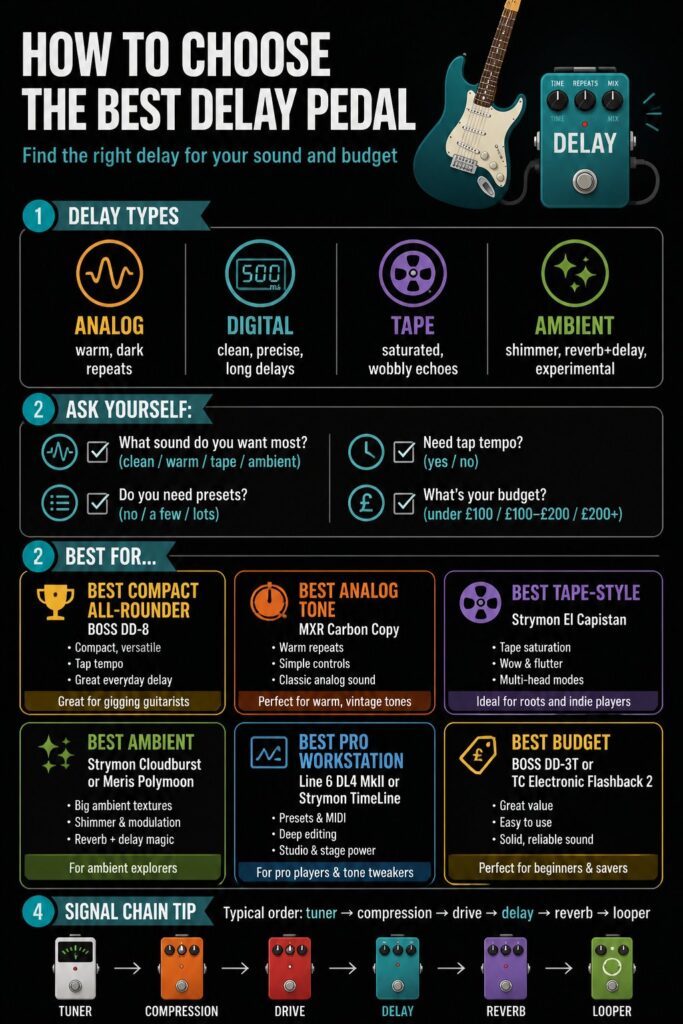
Delay pedals are one of the most versatile tools in a guitarist’s kit — they can thicken a rhythm part, fatten a lead, or build huge ambient soundscapes. But there’s no single “best” delay pedal: the right choice depends on the sound you want, how you play, and how much board space and cash you have. Use this short guide to back up the infographic and help you pick a pedal that fits your music, not just your wishlist.
You Have To Understand the Delay types
- Analog: If you want warm, dark repeats with a slightly lo-fi character, analog delays (bucket‑brigade devices) are the go‑to. They typically have shorter max delay times and natural decay, and they respond musically to playing dynamics. Ideal for blues, classic rock, and any setting where tone and feel matter more than pristine fidelity.
- Digital: Clean, precise, and capable of long delay times, digital delays do everything from slapback to shimmering rhythmic repeats. They’re perfect when you need accurate subdivisions, long repeats, or transparent echoes that don’t colour your core tone.
- Tape: Tape‑style delays recreate the saturated, wobbling sound of reel echo units. These pedals bring character — wow & flutter, slight pitch instability, and natural compression — excellent for vintage vibes and lo‑fi textures.
- Ambient: Ambient delays combine long repeats with modulation, shimmer, and reverb to create washier, evolving sounds. If you play ambient, post‑rock, or worship music, this is where you’ll find pedals that do far more than simple repeats.
Ask the right questions first
Start by answering four quick questions before comparing specs: What sound do you want most (clean, warm, tape, or ambient)? Do you need presets or MIDI for quick recall? Is tap tempo essential for live use? What’s your budget? The infographic’s decision boxes translate these answers into specific pedal types and recommendations — this is what narrows the field and saves you from buyer’s remorse.
Best pedal categories (and quick picks)
- Best compact all‑rounder — BOSS DD‑8
The DD‑8 is a compact digital delay that covers a huge range of sounds with user‑friendly controls and tap tempo. It’s the ideal single‑pedal solution if you want versatility without a big footprint. - Best analog tone — MXR Carbon Copy
For warm, organic repeats with musical decay, the Carbon Copy remains a benchmark. It’s simple, musical, and the natural choice for players chasing vintage flavour. - Best tape‑style — Strymon El Capistan
El Capistan nails authentic tape echo behaviour, including head‑stops and wow & flutter. If tape character is your priority, this one delivers in spades. - Best ambient — Strymon Cloudburst or Meris Polymoon
Both pedals excel at creating vast textures. Use them for shimmer, long evolving repeats, and reverby delay blends that sit more like pads than echoes. - Best pro workstation — Line 6 DL4 MkII or Strymon TimeLine
For players who need presets, MIDI control, and deep editing, these are studio‑grade tools. They’re heavier on features (and price), but invaluable for gigging pros or recording engineers. - Best budget — BOSS DD‑3T or TC Electronic Flashback 2
Solid, reliable, and affordable; these give you great sound for the money and are perfect for beginners or backup units.
How to interpret features quickly
- Tap tempo: essential if you play live and change song tempos.
- Presets & MIDI: choose these if you swap settings between songs or use a preset‑based rig.
- Stereo I/O: important for ambient/ambient-plus-reverb rigs and split stereo amplifiers.
- Looper: nice to have for practice and songwriting; not essential for everyone.
- Size & power: check footprint and power requirements—pro pedals often need 9V DC with specific current draw or isolated supplies.
Signal‑chain and practical tips
A typical placement for delay is after drive/overdrive pedals but before reverb and looper. That order keeps repeats clear and allows reverb to wash both dry and repeated notes, creating a more natural space. Try swapping delay before or after modulation or reverb to hear how the character changes — small experiments like this are how great tones are discovered.
Quick buying checklist
- Pick the sound first (analog/digital/tape/ambient).
- Decide whether presets/MIDI/tap tempo are must‑haves.
- Set a budget and narrow to two models per category.
- Check size and power requirements against your pedalboard.
- Read 2–3 user reviews and listen to sound demos before buying.
Wrap up- My Opinion
The infographic above gives you a fast decision path; this article expands the reasons behind those choices so you can buy with confidence. A delay pedal is more than a list of specs — it’s an expression tool. Choose one that helps you make the sounds you hear in your head and supports the way you play.