How To Choose The Best Volume Pedal For Your Rig
Picking a volume pedal seems simple until you actually start shopping. There are passive options, active designs, different impedances, varying treadle sizes, tuner outputs, and expression modes—suddenly a straightforward purchase turns into a rabbit hole.
The right volume pedal for your rig depends on three things above everything else: where it sits in your signal chain, whether it matches the impedance of your pickups or buffer, and how the treadle sweep feels under your foot in real use. Nail those three, and almost any other feature is a bonus.
Get them wrong, and you end up with tone suck, a scratchy sweep, or a pedal that physically fights your foot during a quiet swell.
I’ve spent a fair amount of time running different volume pedals through real setups, from passive single-coil guitars to active basses. The lessons from those sessions are what I’m organizing here.
Whether you’re buying your first volume pedal or replacing a clunky older one, this guide is meant to give you honest, practical direction—like what a knowledgeable friend would say before you hand over your money.
Key Takeaways
- Impedance matching and passive versus active design have a bigger impact on your tone than brand name alone.
- Where you place a volume pedal in your signal chain changes what it actually controls and how useful it is on stage.
- Features like tuner output, minimum volume control, and treadle size matter more in practice than most buyers expect before they gig with one.
Start With Your Rig And Placement
Signal chain placement and what you actually want the pedal to do are the two decisions you should make first. Sorting those out early keeps you from buying the wrong tool entirely.
What You Want The Pedal To Do In Your Signal Chain
Think about your main reason for adding a volume pedal. Some players want hands-free volume control for a solo boost without bending down to a knob.
Others want smooth, ambient swells—the kind pedal steel players and ambient guitarists lean on. A few just want to kill their signal cleanly between songs.
Each use case has slightly different priorities. Swell players need a smooth, predictable taper with a wide throw.
Solo boost users care more about a stable heel-down position and minimal coloring. If you’re running long cable runs to a wet/dry rig, impedance becomes even more critical.
Front-Of-Chain Vs End-Of-Chain Placement
Placing a volume pedal at the front of your signal chain, right after your guitar, means it controls the raw instrument signal. Rolling back the volume affects how hard you’re hitting your drives and fuzz pedals downstream, which can clean up your tone dynamically without changing your amp settings.
That’s a useful trick, but it also means the pedal needs to handle high-impedance signals cleanly. At the end of the chain, or inside an effects loop, the volume pedal controls the full processed signal level.
This works better for global volume adjustments and swell effects on top of ambient or reverb-heavy rigs. Placement changes everything about how your drives behave.
When Silent Tuning And Tuner Output Matter
A built-in tuner out jack sounds minor until you actually use it. With a tuner output, you can plug a tuner into the dedicated jack and tune silently at heel-down position without a separate mute switch.
I find this genuinely useful at gigs when I need to retune between songs without cutting my stage signal awkwardly. Not every volume pedal includes a tuner-output jack.
If silent tuning matters to you, double-check it’s there before buying. Budget and compact models often skip it to save space.
Match The Electronics To Your Setup
The electronics inside a volume pedal decide whether it preserves your tone or quietly degrades it. The difference between passive and active design is the most important variable to figure out.
Taper type is the second thing to check, because it shapes how the pedal actually feels to play.
Passive Vs Active Designs In Plain English
A passive volume pedal is basically a pot (potentiometer) wired into your signal path. No battery, no power supply required.
It works by physically reducing the signal as you move the treadle—simple and reliable. The tradeoff is that a passive pedal is sensitive to impedance.
Put the wrong impedance passive pedal in the wrong spot and you get tone suck: a noticeable loss of high frequencies and clarity. An active volume pedal uses a powered circuit, sometimes a VCA design (voltage-controlled amplifier) or a magnetic VCA, to control the signal.
Active designs offer a buffered output, which means they drive long cable runs without signal degradation and play nicely across most rig configurations. They cost more and require power, but tone preservation is more reliable across setups.
How Impedance Matching Prevents Tone Loss
For passive guitar pickups running directly into a passive volume pedal, you need a high-impedance pedal—usually 250k or 500k ohms. Using a low-impedance 25k pedal in that spot loads your pickups incorrectly and bleeds off treble before the signal even reaches your first drive pedal.
If your volume pedal sits after a buffer or inside an effects loop, a low-impedance 25k model works correctly and often tracks more smoothly. The Ernie Ball VP Jr comes in both 250k and 25k versions for exactly this reason.
Matching impedance isn’t overthinking; it’s a two-second check that saves your tone. You’ll thank yourself later.
Audio Taper, Linear Taper, And Sweep Feel
Audio taper (also called logarithmic taper) matches how human hearing perceives volume changes. It gives you a gradual, musical swell through the middle of the treadle throw and a more dramatic change near heel-down.
Most guitar players prefer this for swells and general use. Linear taper divides the volume change evenly across the entire sweep.
This can feel abrupt and less controllable for swell work, though some players prefer it for precise level-setting. A switchable taper option, found on a handful of models, gives you both.
If smooth volume swells are central to your playing, prioritize audio taper. It just feels better for most of us.
Choose The Features And Feel You Will Actually Use
Features that look compelling on a spec sheet don’t always earn their keep on a real pedalboard. Knowing which extras actually change how you play versus which ones just add cost helps you spend smarter.
Volume-Only Vs Volume And Expression Models
Some volume pedals double as an expression pedal, meaning you can connect them to a synth, multi-effects unit, or any pedal with an expression input and use the treadle to control parameters like reverb depth, delay feedback, or filter cutoff. Volume and expression pedals like the Hotone Ampero Press and the Hotone Soul Press II pull this off in a compact form factor.
If you already own a dedicated expression pedal or don’t use expression control at all, a volume-only model is simpler and often built more ruggedly for that single purpose. The dual-mode approach is genuinely useful if pedalboard space is tight and you want both functions from one unit.
Just confirm whether the pedal can run both functions at once or requires switching modes. It’s a small detail but makes a difference.
Minimum Volume Controls, Boost, And Extra Utility
A minimum volume knob lets you set a floor so that heel-down position never fully silences the signal. This is useful for studio work or controlled dynamic playing where you want a pad rather than a full mute.
Some players also use it to dial in a rhythm volume at heel-down and a lead volume at toe-down, basically creating a hands-free solo boost. Not every volume pedal includes this control, so check if this kind of utility matters to your playing.
A polarity switch is another optional feature on some expression-capable models, allowing compatibility with gear that expects different polarity from the expression input jack.
Size, Torque, And Treadle Comfort On A Crowded Board
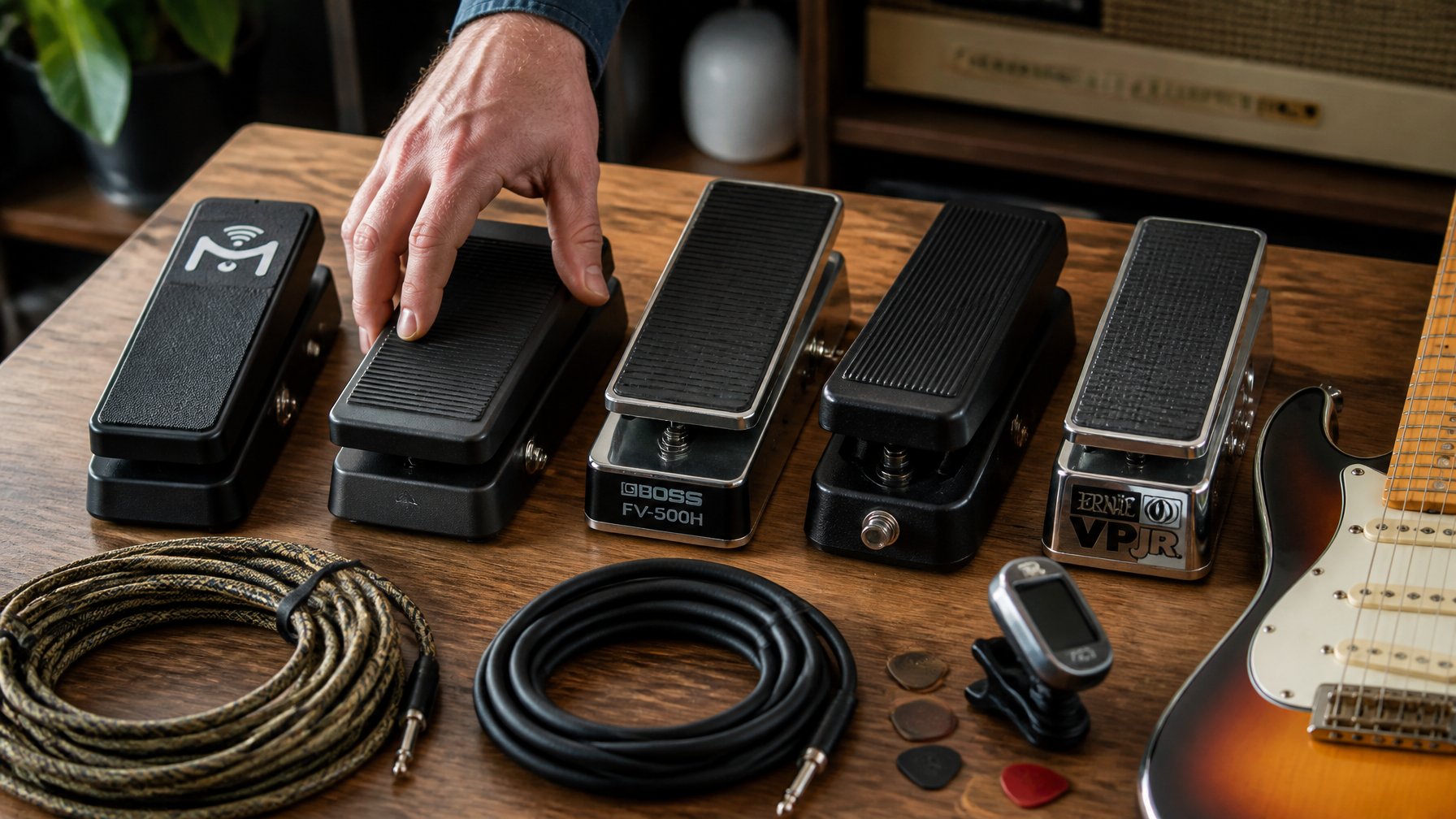
Pedalboard footprint is a real constraint. A full-size volume pedal like the Boss FV-500H gives you a large treadle platform that’s easy to control precisely, but it takes up significant board space.
A compact or mini volume pedal trades platform size for a smaller footprint, which suits tighter boards but demands more foot precision. Adjustable torque is one of the most underrated features I look for.
Being able to tighten or loosen the treadle resistance lets you tune it to your playing style, whether you want a heavy, deliberate feel for swells or a lighter, more responsive action for quick dips. Nylon pivot bushings wear out faster than metal alternatives, so check what the mechanism is made of if durability matters to you for gigging.
Compare Popular Types And Real-World Picks
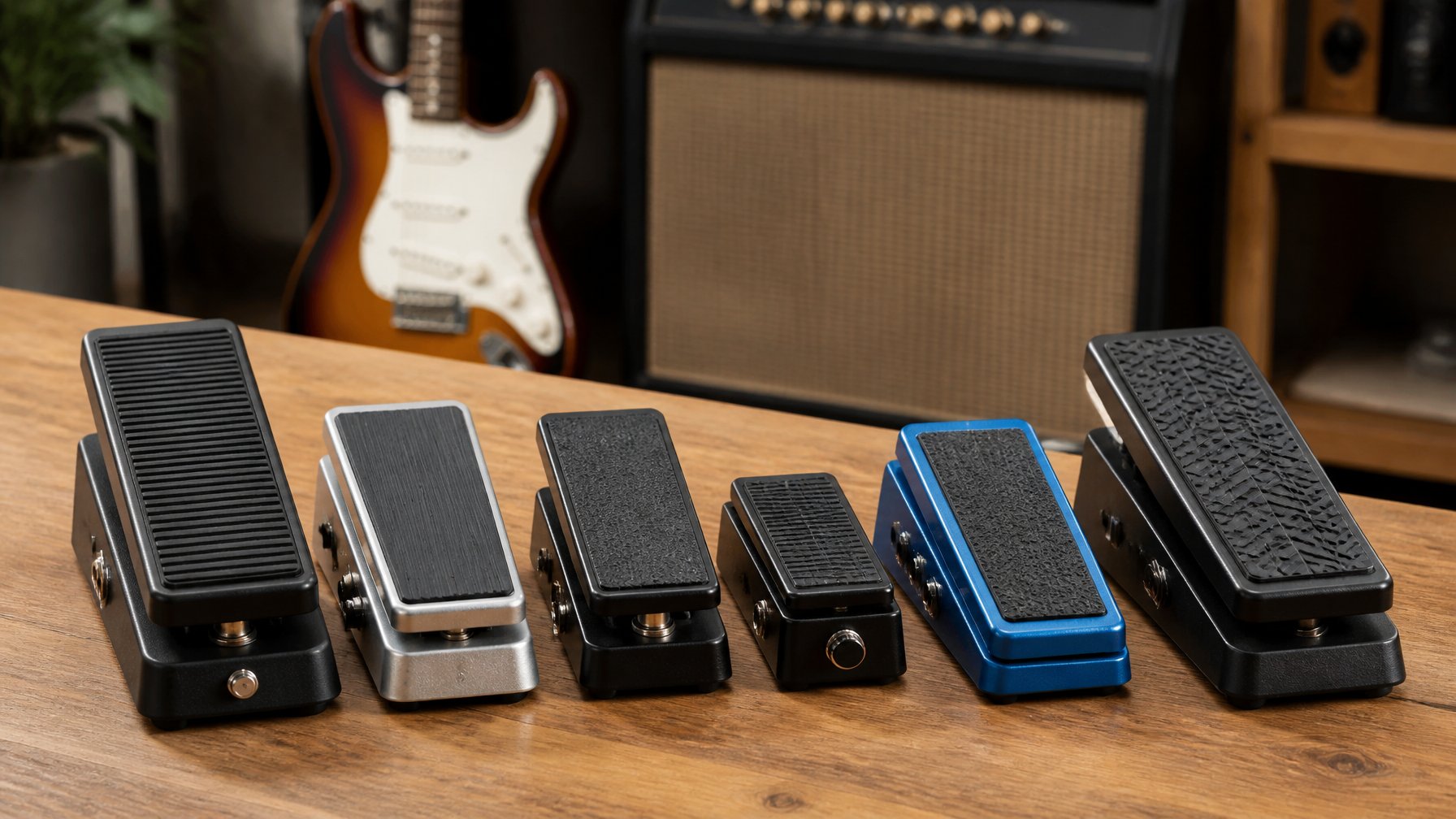
The market splits into budget, mid-range, and premium tiers. Each tier has models that are genuinely well-suited to certain rigs while being a poor match for others.
Knowing what each type is optimized for saves time and money.
Best Fits For Budget, Compact, And Premium Buyers
Budget tier: The Behringer FCV100 and the SONICAKE VolWah are the most affordable options worth considering. The Behringer is a passive pedal that works fine for players on a tight budget who just need basic hands-free volume control.
The SONICAKE adds active circuitry and wah functionality in one unit, which is interesting but niche. Neither feels as solid as mid-range options under a moving foot.
Compact tier: The Ernie Ball VP Jr in 250k (for passive pickups) or 25k (for post-buffer placement) is the most proven compact passive pedal on the market. It’s road-tested, widely used, and relatively affordable.
The Xotic XVP-250K is a premium compact passive option with a narrower footprint and smoother taper that many players prefer if they can spend more.
Premium tier: The Lehle Mono Volume pedal is what I point players toward when they want a passive design that truly doesn’t color the signal. Its build quality is exceptional, and the sweep is smooth and predictable.
For active or optical designs, the Morley 20/20 Volume Plus removes the pot entirely and uses optical sensing, which means no physical wear component and a highly consistent feel over time.
Proven Picks For Passive Pickup Rigs
For a standard guitar running directly into a pedalboard without a buffer early in the chain, the Ernie Ball VP Jr 250k is the most practical starting point. It’s compact, uses a band-drive mechanism that’s easy to replace if it ever wears, and the 250k impedance matches a passive guitar’s output correctly.
The Boss FV-500H is a larger option in the same passive, high-impedance category. It adds a useful tuner output jack and a bigger treadle platform for players who find compact models too small for precise foot control.
If your board has the space, the bigger treadle can make swell work noticeably easier.
When To Step Up To Active Or Optical Designs
If your signal chain already includes a buffer early on, or you use active pickups, you’ll get better results from an active volume pedal. Long cable runs before or after the volume pedal also make active designs a smarter choice.
The Ernie Ball MVP (Most Valuable Pedal) stands out as a solid active option. It’s got a built-in buffer and a tuner output, all in a form factor close to the VP Jr.
The Morley 20/20 Volume Plus really makes a case for optical design. The optical sensor never touches the pot, so you won’t get scratching, dead spots, or that annoying taper wear after years of use.
If you’re gigging a lot and stomping on your volume pedal night after night, that kind of durability is honestly worth the price jump over basic passive pedals.
Frequently Asked Questions
Should I choose an active or passive volume pedal for my setup?
Go with passive if your guitar plugs straight into the pedal and you want something simple that doesn’t need power. If you’ve got a buffer early in your chain, use active pickups, need to push long cable runs, or want a built-in buffered output to smooth out impedance mismatches, then active is the way to go.
What impedance range should my volume pedal match for guitar or bass?
For a passive guitar or bass going straight into a passive volume pedal, stick with a 250k or 500k ohm model. That’ll match your pickups’ high-impedance output.
If you’re running the pedal after a buffer or in an effects loop, you’ll want a 25k model. It’ll track better in that lower-impedance spot.
Where should a volume pedal go in the signal chain: before drives, after drives, or in the effects loop?
Putting it at the front lets you control how hard you hit your drives, so you can clean up your amp tone as you roll back. After drives or in the loop, the pedal manages your whole processed signal, which is great for overall volume tweaks or those ambient swells that float on top of your reverb and delay.
How do I decide between a full-size and a mini volume pedal for comfort and control?
Full-size pedals like the Boss FV-500H offer a wide treadle that’s much easier to control for smooth swells. Mini pedals like the Ernie Ball VP Jr or Xotic XVP-250K save space but demand more accurate foot placement, especially if you’re into slow, controlled swells.
What differences should I look for between popular models like Lehle and Dunlop volume pedals?
The Lehle Mono Volume is a top-tier passive pedal—super tight tolerances, transparent sound, and hardware that just lasts. The Dunlop DVP3 is more mid-range, with a wider treadle and a tuner output, but its taper feel and build aren’t quite on Lehle’s level.
Honestly, the choice comes down to your budget and how much you care about tonal transparency in your setup.
Which features matter most for durability and smooth volume swells (taper, throw, and build quality)?
Audio taper stands out as the key factor for smooth, musical swells. It lines up with how our ears actually perceive changes in volume.
A longer treadle throw means you get more precise control throughout the sweep. That’s something you’ll notice if you want subtlety and detail in your playing.
When it comes to durability, I always lean toward metal construction. It just feels more solid and less likely to break down after a few gigs.
Band-drive or optical mechanisms usually outlast bare pots, which can wear out or get scratchy. Adjustable torque is also handy, letting you keep the treadle resistance just right as the pedal gets older.